Tuesday, May 29, 2018

Spinner & Cowling


Section 47

Spinner

Mounting of the actual propeller is one of those times when you just stand back and marvel at the awesomeness.  Making it even more awesome, as shown in the picture I went with the gorgeous 3-blade Hartzell composite propeller. This decision wasn't really grounded in actual performance gains but more or less for up cosmetic ramp appeal.  It just makes the plane look fast, even if it's not moving. There are some benefits supposedly with going this route.  It's a lighter propeller and it may be smoother, it's reduced diameter has an added benefit in mitigating prop strikes. In reality though I'm sure I'm just looking to justify the added expense...

The stock spinner you receive is a fiberglass cone which takes some modification to work with your installation.  I am unable to use that with a 3-blade and instead I bought the Hartzell shiny polished spinner to use.  Because I had no part fabrication this  section was fairly straight forward and even though mounting the prop was a bit cumbersome, I was able to do it solo without many issues.


Now the above picture was taken awhile ago, prior to initial fit of the cowl. You need the prop, or some sort of back-plate installed to get the proper spacing between the cowling and prop bulkhead.  The goal for this is 1/8th of an inch which is pretty tight.  I didn't trust my template making skills so instead just decided to use the real deal.

Removal and installation the propeller doesn't take all that long, but is a bit awkward.  I've found using some of my custom made floor jacks help to act as a shelf to get the alignment down.  Then it's a matter of tightening 6 bolts in the typical cross pattern fashion until everything is secure.  Torque it up to 25 ft lbs or 300 in lbs (For my Propeller) and call it good.  For my first install I used a typical open ended wrench which was a bit of a pain and I had no method to torque it down.  The torque wrench called out in the Hartzell manual is a good $600.  If you can borrow one great, if not do yourself a favor and buy the Ultimate Propeller Wrench. Not only does it speed up the nut turning but then you flip it over and you can attach a torque wrench in the typical 90 degree fashion for your final torques!

Cowling

Out of all the sections I've worked so far I found this by far the most annoying and frustrating... a close second is still the doors. I take responsibility for the frustration though, it is entirely my fault for the add complication and time. Having added Pin covers, Air Conditioning, Ramair, oil door, cowl flaps and the such really are all self induced, per the plans might be less frustrating but I won't know on this build.  The rest of it is just the nature of fiberglass which still is a bit of a challenge for me.

Followed the plans for the most part in getting things clammed together, doing some sanding, trimming and more sanding.  You'll notice the cut out for AC Compressor clearance and a big cutout to get around the Ramair unit.


I find when I'm working through a task and getting pissed or otherwise frustrated that I don't seem to take pictures.  Here's a quick run down of the work.  There's was a lot of sanding to get the two halves together.  The idea is to get them even with the smallest gap possible.  I used rulers, lasers, tape... anything to try and ensure it's symmetrical and even. I obsessed a bit about this and spent at least 3 work sessions on doing all this... good news is it's fiberglass so if you mess up you can easily repair.


The next hurdle came with putting the clams together and cutting the back off so they are a good 1/8 back from prop and even wit the fuselage. The plans call for measuring a line 3" back, placing the cowling on and then measuring a line 3" forward.  I botched this up a bit and end up cutting off too much in some places.  I thought about using the laser for this and in hind sight that's what I should of done.  My concern though was as it bends over the top and bottom that it wouldn't line up.  Either way it was fit on and then attached the other half of piano hinges.  Fairly straight forward, had to do some spot sanding in some areas.

Once the backs were attached then I had to work the sidelines.  To be honest I'm not 100% sure how I did this.  I'm pretty sure I just made a line with a ruler and started trimming.  Then attached the piano hinges and all that and squeezed everything together.  Spacing is always a concern so I reached out to a 3 time builder to ask advice on what he did.  He suggested using a Perma-grit F102 to work the consistent spacing.  This worked out fantastic and even though it seems a little wide, I know paint will fill it but it's still not too tight that it will crack the paint.

With the sides being near perfect I was left with dealing with the back of the cowl.  Some of the repair was easy just micro/epoxy fill. Some required me doing a scarf joint and using cloth.  It was a back and forth deal of adding, sanding, testing strength, fixing etc.


Attached
The above picture wasn't the finished product, but it was on enough that I could continue work on the baffles as well as start finishing, working the Ramair etc.

Oil Door

I'm not overly impressed with the plans oil door.  It seems flimsy, you have to manually hold it up, the fasteners don't look streamlined... I followed other builders and decided to change it up.  I bent up some aluminium to match the door profile and using some adhesives secured those together.  Then I bought a hidden door hinge and some different fasteners and put it all together.   Took some micro filling and sanding to get it all smoothed out but I like how it turned out in the end.


This finishing touched on the oil door was another process in itself.  I bought and installed these push camlocs for the opening and closing mechanism.  They initially worked well cleco'd on but once I painted the pack of it started the micro fill work I wasn't happy with it at all.  I ended up stripping the paint from the backside of the door, adding some shims to hold the latch mechanisms providing better clearance and then I was able to reinforce their attach points with a few strips of aluminum.  I bought some 5/8 hole covers also and used some 3M adhesive to act as the button extenders.  The rest was a matter of filling in some of the gaps to make it a smooth run, sand, epoxy, sand and here's what I ended up with.


RamAir

Lets talk a bit about Rod Bower Aviation products.  My reasoning in going with these products was ultimately to enhanced performance at a cheaper cost point than a typical cold air induction setup.  There are some utility benefits as well. These include easier removal of the cowling with a 3-blade propeller and a built in alternate air source.  I can't speak about the results because I'm not flying yet but two people I've spoken with are very happy with their results and have easily achieved an extra 1" on manifold at altitude.

If you're going down this path on an RV-10 you need to make sure you're getting all the right pieces.  Even though I ordered mine less than a year ago there have been some changes to unit.  I was able to send my unit back in for a nominal labor fee and have it retrofitted to the newer Enhanced Filter Air canister. The difference in the two units are rectangle vs oval reeds, with the rectangles apparently being more efficient than even the stock set up. Next I picked up the Rambo Elbow which re-positions your servo horizontal and forward facing giving it a straight shot of air vs the typical updraft model.  No clue how that affects performance but we'll see.

To be completely honest the biggest challenge I had was with the fiberglass scoop. The original one sent to me fit the cowling great if the canister was in the original position. With the elbow and forward facing fuel servo it moves it up and out and the stock location wasn't going to work.  It was obvious to me that it wasn't going to fit initially.  I thought maybe when you used the elbow you had to do some fiberglass work, sent some pictures and emails to Rod and got some advice on how to make it work. In his defense he's not standing in my garage so it's probably a bit challenging to understand what the issue is. We had a number of conversations and I was ready to bastardize the scoop I had to get it to work. Rod gave me some suggestions on cutting the flanges off, how to position it etc.  Even after doing that there was no possible way this was going to work.  At this point I'm reading through making molds and all sorts of stuff and came across Larry's thread on his install.

A couple things I noticed, 1) he has the old oval reed openings, 2) he had to machine his elbow to put a 3 degree angle in it and now Rod sells spacer for that, 3) His cowl scoop looks amazing!  So I reached out to him to see what sort of techniques he used to get such a great fit and he said he had to do very little..... Okay at this point I knew without a doubt I had the wrong scoop so I sent Rod some of the pictures and essentially said 'I need what Larry used'.

I hate that I ruined the original scoop so couldn't send it back, but I was more than willing to buy the new scoop which I did.  A few weeks later I had the new scoop, which essentially fits perfectly. All I did was even out the flanges a bit but other than that I didn't have to do any major fitting. All in all in the scoop I'm guessing I spent less than 3 hours fitting it, cutting the matching hole and working the micro and fiberglass work.  I spent another hour or so installing the camlocks and now I also have an amazing scoop!

Cowl Flaps

Lets talk Cylinder Head Temps (CHT).  In the RV-10 I'm flying now you have to shallow your climb pretty soon after lift off to keep the CHTs under 400 degrees.  This threshold is optimal as you don't want to burn them out or be overly hard on your engine.  There are troves of information out there on a variety of topics to reduce the CHTs. There are a number of builder who do pretty much everything possible and still end up not being able to climb at their maximum rate, and those in hot climates such as mine that really have to reduce their performance to keep CHTs down. The solution for me are using Cowl Flaps in order to increase airflow on climb out.  Cowlflaps aren't a new idea and have been around at least since at least WWII.  I've flown planes with them and I don't find their use overly complex so wanted to incorporate them.

This is obviously a deviation in the planes and require some modifications.  They go in place of the stock vents and you'll want to make sure that at no time are they interfering with the exhaust.  Two major issues come up when you plan the install.  The first issue if the only place to avoid interference is at the inner most corner all the way back.  This causes you to have to figure out a method of attaching the center brace piece along with the flaps.

The second the flaps will be proud of the cowl, sticking out a good 1/8in inch of you don't build up the material behind it.  Other builders have come up with methods of building up the area.  I tried to make a metal bracket but was having some consistency issues with my given workshop.  I decided instead to build up the area with good old fiberglass.  I started with 4 layers of pretty thick fiberglass tape, alternating the seams for rigidity.  Next I made up some fairly think epoxy/milled fiber mixture and just laid it on thick.  Once it started to set I manipulated it by hand a bit and then covered with peel ply and smashed the units down to get it somewhat even.  Once cured it was a sanding marathon until you get it level and flush. To attach I decided to use countersunk screws and self locking (Non-nylon) type nuts. 


With increasing this thickness you need to modify your closeout piece.  I went ahead and just sandwiched two scrap fiberglass pieces and a piece of aluminium together with the stock piece.  This gives you a line to trim and sand and in the end you end up with a not overly heavy thick piece that will work with this new set up.  As shown in Ed's build log above you have to bend your brace a bit, it's not structural so it's a non-factor.  You'll have to use much longer rivets obviously, and for the final screws for the nutplates I had to order some longer ones as well.


I will have to finish the wiring up later when I figure out how I'm going to route it.  It's important to control the heat, I have little heat shields I can attach to the pipe, but I will also have to cover any wiring with fire barrier and foil.

Cowl Finishing

I was extremely happy once I got to more mundane parts that really required just time.  Putting on nutplates, skim coats and painting the interior etc. takes a bit of effort but it's fairly straight forward.  I again used the same coating, think filler paint I used on the top and doors to finish up the cowling.  I rolled on 3 coats and let cure for... and I let it cure for weeks to be more exact. The idea is that you ensure it's fully cured and won't do any additional shrinking post sanding.  Here's what it looked like prior to sanding.

Pre-sand
Post-sand
I also decided to reconstruct my original custom inlet ramp. My first attempt didn't allow the clearance required to get the cowling over the AC Compressor while being able to put the cowling behind the bulkhead.  I ended up trimming off a bit to make it fit and frankly felt that the air would end up shooting under the baffle rather than over it.  Time to rebuild it....

It wasn't especially difficult, but it did take me two 'prototypes' to get something I liked. The basic idea was to make a larger more gradual slop in order to direct air flow to the top of the baffle.  It also made sense to me to make it removable, thus ensuring no issues with compressor clearance during cowl installation or removal.


Used clay to mold the shape I was looking for.

After initial layup over the clay, let it cure, drilled some placement holes.  Trimed and shaped the top piece how I wanted it.  I then essentially reshaped the lower cowl to fit the new ramp and now it's about twice as thick as the other side, even after sanding the back a bit.  I topped everything with several thick coats of primer to function as a high build layer and let it cure for 4 days.  Then hit it up with some 320 to smooth it out and finished with nutplates and some countersunk screws.


It's not pretty but it should be functional and will get cleaned up along with the rest of the fiber glass come final paint. At first glance it looks like it will restrict airflow but really I just replaced the metal baffle ramp with fiberglass that will deliver the  air to the top.


After all this angst and agony my cowling is essentially complete. I'm extremely happy with the way everything turned out.  If I had to change something I would of actually probably have done camlocs around the back of the top cowling.  It is seriously a huge pain to take on and off.  Sure it would have been another mod but I'm guessing it would of saved countless hours over the life of the plane.

I decided to leave the cowling off for these final section pictures.  I anticipate waiting to recowl the plane until I make the move to the hangar.


Wednesday, May 23, 2018

Overhead Lighting Layout


With my cowling 99% finished and all pumped up after a vigorous workout, I decided to tackle the cabin lighting. You would think something light cabin lighting would be a simple en devour.  The concept hasn't really changed much and most of us did night flights in training with a red post light, or maybe a flashlight that can alternate between red and white. There however are a mess of choices and custom setups out there. I decided to keep it simple and go with two red, two white and a headset hanger.

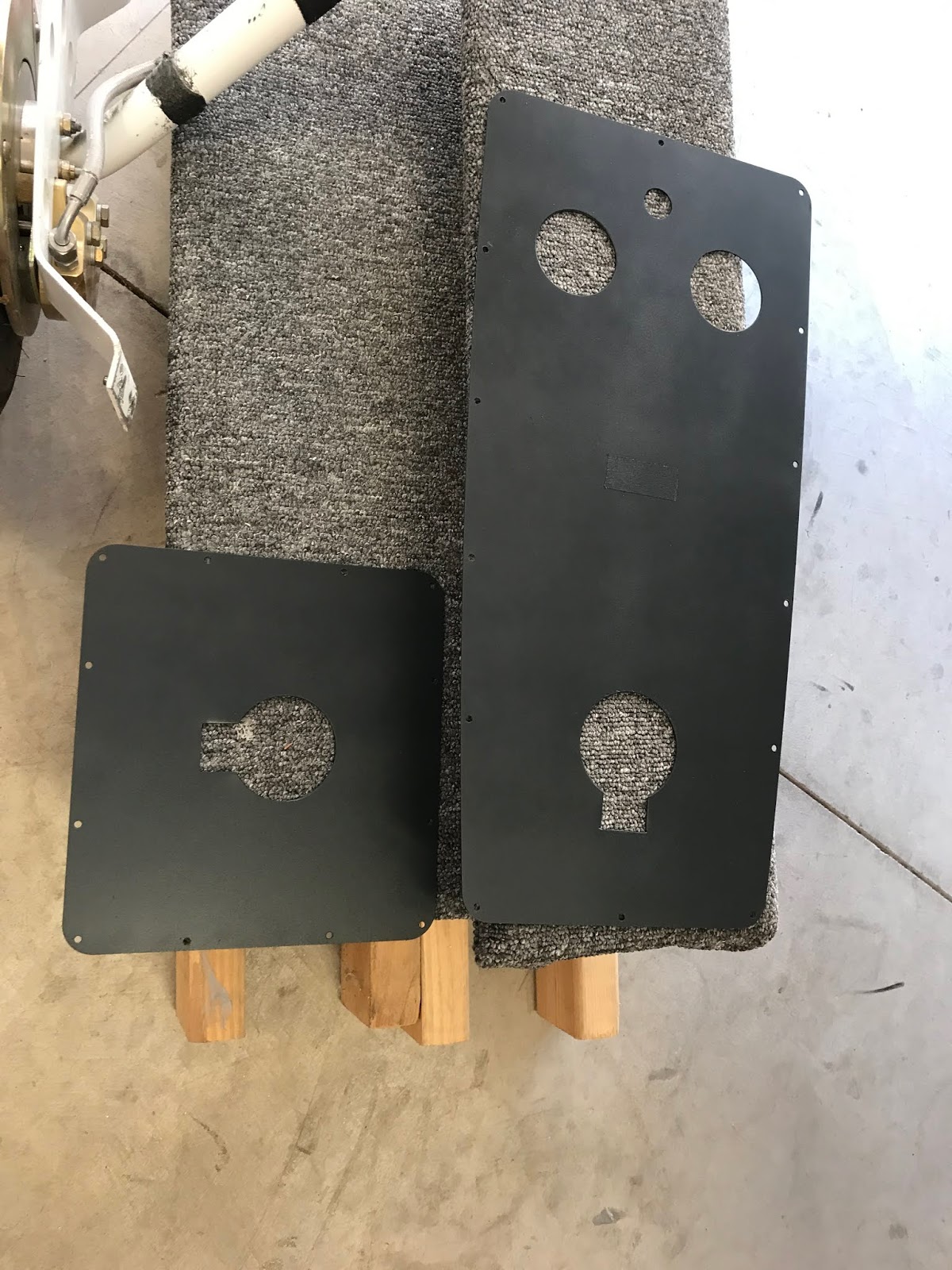
I've had the parts for a bit, the inserts came with my Aerosport overhead and I picked up some lights from PilotLights.net. They have a lot of choices out there and I picked some red eyeball lights for the front and back and some low profile white lights for the mid cabin area.  These will eventually be wired up to a rheostat and I have switches for each light.  Once the placement was worked through it was a matter of drilling/cutting out some holes and test fitting. Once I was happy with it all I prepped the blanks for paint and started the process. Just did the standard priming, color top coat and low luster clear.

Don't have a picture of them panels installed yet, so a crooked picture on my garage floor will have to do.  These should work out great, they look nice and serve the function of lighting.  


Wednesday, April 18, 2018

1000 Hour Milestone! Fuel System & Oil System

1000 Hour Milestone!

Before I get into my progress I wanted to point out a particular build milestone. Out of curiosity, while typing this up I wanted to add up the hours I've spent on this build and low and behold I'm a handful of hours away from 1000 hours build time (Will get there tomorrow).  What does this mean?  Well nothing really only that I've spent 1000 hours bucking rivets, cutting/shaping aluminium, deburring, fiber-glassing and all the other fun exciting things you get to do when you build yourself an RV.  What it doesn't take into account is the countless hours you spend researching and dwelling over every aspect of the build. I won't even speculate on how much time I've spent on those activities.

A rough estimate Vans gives you on an RV-10 build is around 2000 hours.  So that would mean on a standard build I should be about halfway done, however I did a quick build which is estimated to save around 1000 hours.  So why am I not done??? It's pretty obvious to me that I have greatly increased my building time (and costs) through a number of modifications or plan deviations which exponentially increase the time you spend on particular steps.   Priming alone will add a good 50 hours to your build.  Add an air-conditioner, add another 50 hours.  Want full blown interior? 50 hours...  you get the point.  The current RV-10 I've been flying is essentially plans built with a carbonated engine and steam gauges and is pretty awesome.

My advice is the same advice given to me and that if you want to streamline your build, reduce headaches and unknown costs then just build it per the plans.  If I had done that I would probably be wrapping up by now... however if you want to customize your build, put what you want in it... that's part of the fun of experimental but comprehend the price/time trade-off.  If I had to do it over again knowing what I know now I would probably not do a few things. That said I'm not flying this yet so can't say anything definitive.  Back to the build....

Fuel System

Section FF4
When it comes to these sections I really need to credit Tom with TSFlightlines for helping me out.  He worked with me on figuring out where and how to mount the fuel transducer and custom made my fuel and oil lines to my specific measurements.  Making really the hardest part of these sections doing the measuring of the lines.  If you have a complete stock setup he has those measurements and can just send you the lines, similar to when I ordered my brake and internal fuel lines.

Firewall forward though my system is a bit out of the norm with my forward facing servo.  After taking some time to work through some things, I ended up happy with the routing and obviously the quality of the lines.  Here's some pics

Firewall to Mechanical Pump
Mechanical pump
Line to Servo
Cube right off servo
From Cube/Servo to Distributor

 Oil System

Section FF5
For the oil system I went with the larger Airflow Systems Oil Cooler. Given some of the heat I fly in I wanted the extra cooling.  I am also using a butterfly valve kit from TCW. This allows me to control the airflow and in turn control the oil temp better.  The idea in the summer have it wide open, in the winter time you can close it a bit to ensure your oil heats enough to boil out any water. Water/Oil mix in a sitting engine is bad! These modifications were fairly simple to do. I haven't mounted the servo yet for the butterfly valve but the rest is done!
Oil Cooler and Lines
Overflow and Oil Pressure
Oil Pressure into engine

Engine Plumbing Complete!

Sunday, March 18, 2018

Exhaust System


Section FF6
Jumped from FF2 straight to FF6...  Section 3 - 5 deal with cables and lines which I am getting custom made.  I thought about waiting till all that was done before installing the exhaust system, it would sure make it easier to do this and the FWF wiring if the exhaust wasn't in place... but I don't like the easy route so I decided to make the build even more challenging by mounting the exhaust! 

In reality my decision to go ahead and mount the exhaust was a bit more practical.  I have no idea how I'm going to route the fuel lines, control cables, oil lines, cowl flaps and all the little bits and pieces that will be crammed into the engine compartment.  If I did all these and then installed the exhaust there's a high probability I would have ended up having to redo items that conflicted with the exhaust.  With the exhaust in, I can route around it... a bit more challenging but will ensure no conflicts.

If you take a look at the above graphic you'll see it's actually the directions for an old system they used to have.  They tell you to follow the directions that came with your exhaust and jump to page 5 where they have a bunch of pictures of the finished install.  The plans that came with the exhaust were 3 pages complete with copies of the hand drawn items tell you how everything hooks up.  Some of it was a little challenging from a bolt manipulation perspective, but it all went on fairly smooth.

Interesting mounting bracket system
Left ramp modification showing fit, worked well.
Final install

Saturday, March 17, 2018

Cowl Baffle

Section FF2
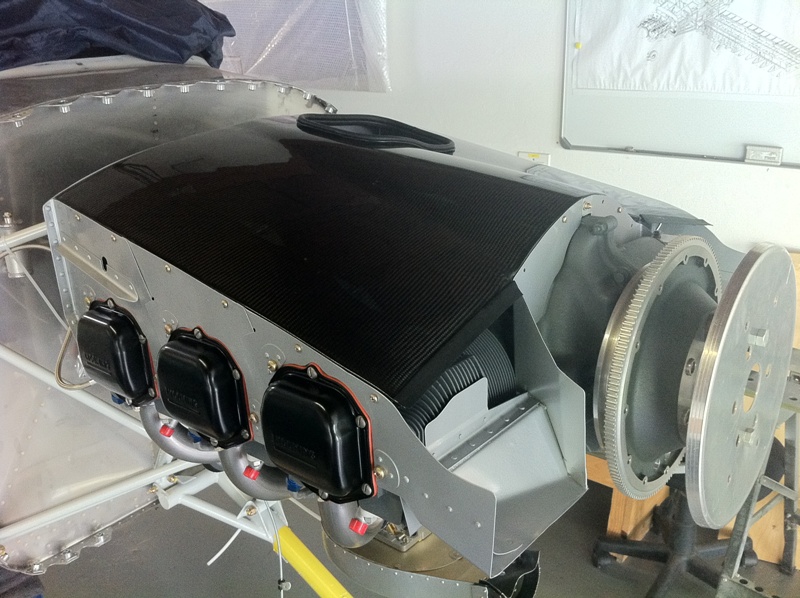
You have two routes you can go in terms of getting cool air to the engine.  One is the use of a plenum while the other is per the plans and essentially uses aluminium dams and a rubber type material to direct the airflow.  I decided to stick with the later in effort to not over complicate things. Initially working through things was fairly straight forward.  Its back to messing with metal and following the directions. Should note that I was doing this section concurrently with the cowl fitting because later in the process you need to start putting the top cowl on to achieve a 3/8 - 1/2 inch gap.  I'll make that it's own section because that has been quite the process.

Once you have the gist of the pieces put together you start test mounting it on the engine.  I went ahead and covered up cylinders 5 and 6 so I wouldn't scratch the valve covers.  There's very little trimming required to get these all on.  Cylinder 6 is tricky but once you figure it out it's a repeatable process to put it on and off. When I got to the pages on the inlet ramps that is where it stopped being straight forward and turned into quite the headache....

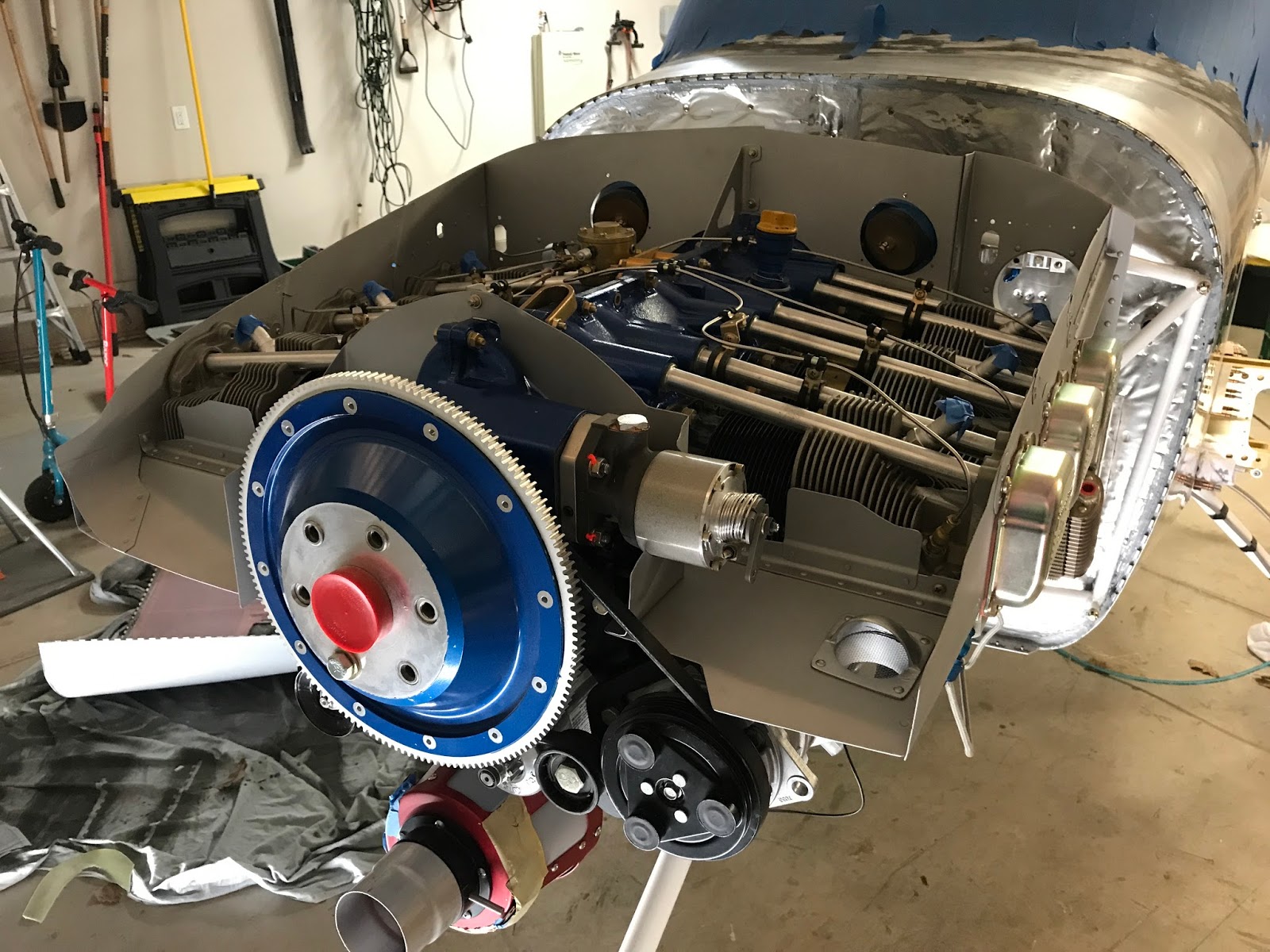
See I'm putting in an Air Conditioning which means I have a compressor located on the port-side of the engine.  This prevents a per the plans install since the inlet ramp can't back downwards.  I actually knew all this going into it so it wasn't a surprise.  Once again I reached out to Greg for some guidance as well as checked out his install. If you look at his pictures he made a fiberglass ramp and keep the inlet ramp moderately flat so I followed suit... hence why I was needing to install the cowl and work the baffles in concurrence.  Before I get into that, here's a nice picture showing the initial fit, when I still had the prop on.


I have a feeling each install is going to be a little different when installing a compressor and there are variances in height and pulley wheel position.  I tried to keep at least an 1/8 inch gap between everything to keep things from rubbing.  Also with the compressor there was a slight challenge getting the front ramp on and off with the governor on.  So I had to loosen the bolts and remove it and then slide it back on to finish out the fitting.  As you can see in the picture (which wasn't the final trim) that a lot of customization was needed.  Especially in the piece around the governor where I used the stock piece but made new flanges and opened up the hole to fit. This is an early picture so it's before I really cleaned things up and made the hole for the exhaust cooler air.


After getting the inlets in place I began trimming the the baffle to get that 3/8 - 1/2 inch gap.  I used the paperclip method for that. You take a lot of material off, a little at a time.  Once the top cowl was able to be reinstalled I focused on a section at a time.  This allowed me to focus on ensuring I wasn't shifting the top and in turn the paperclips in any strange way.  All in all I spent upwards of 4 hours doing this and that was even with some help.

With the final lines drawn I removed everything to make it easier to get a nice smooth consistent line.  After going through and deburring everything in great detail I roughed up to prepare for paint.  Obviously painting in an option but I like the look of a painted baffle, even thought I picked Aluminium as the color.  Also want to make sure you get a paint that can withstand high temperatures, I picked an HVT product from my go-to online paint store RE Paint Supply.


Paint drying
 Once everything dried I was able to get it all put back on the engine.  This includes the governor that I had unbolted to get the custom ramp on and off.  Really like the way it all turned out.


Following the experience of others I went a bit arts and crafts and made paper templates for the baffling material. I wanted to be able to cleco these on so I went ahead and put some 1" thick tape around the perimeter and drilled the holes about 3/8 down and spacing varied depending on the piece but was between 1.5 - 2".  There's one spot over #1 cylinder that there's really not much material so the spacing is more like 3", just had to ensure good RTV coverage later on.

With the holes drilled I started making some templates out of construction paper.  The idea was to have the more forward piece overlapping an inch over the next piece.  Idea being that when air shoots in that it will help force the overlapping down, keeping air from escaping.  With the paper in place I cut the top to have about 2.5 inches of material above the aluminium damns.  This was to account for any variations post install, easier to trim than add.

Not pretty but serves the purpose
Laid out the templates and started cutting the baffle material.  Once cut I went ahead and drilled two of the cleco holes to get it in place and then using a reamer match drilled and cleco the rest.  You need to use Acetone to clean the release residue from the baffle material to ensure good adhesion for later RTV application. Then it's just a matter of using the provided pull rivets and putting everything in place.  After that it was fairly easy to give the material a hair cut to a consistent 2" per Vans suggestion.

Per the plans you have to apply RTV anywhere that air could escape.  My previous work with RTV was out of a little 3 ounce tube which is a pain to work with, especially thinking about trying to run long beads with it.  I picked up a can of this which made easy work of it.

With the major work done I'm calling it good for now.  I need to finish up the tension rods, which I'm replacing the stock stuff with 6-32 all threaded rod which is on order.  Also need to reconnect the spark plugs and need to order the Ignition wire harness seals.  Also anticipate some final trimming as I put the cowling back on, but no reason to go into detail on that stuff.


Saturday, February 10, 2018

Transition Training

I've flown a handful of single piston general aviation planes and each time I spent some time with an instructor doing some transition training. I knew with this project that I would defiantly want to do some type of transition training before launching my project into the air.  There are a few CFIs out there that offer RV-10 training with the closest one to me being Alex in Dallas. I had planned to try and schedule sometime this summer to do this in preparation for my first flight. Luckily for me however a good friend of mine bought back his old RV-10 and offered it up for me to fly!

N188MS
Now my friend isn't the builder, he bought it initially from the original builder who pretty much did a per the plans build.  It has a lot of similarities to what I'm used to flying such as push-pull controls, carbureted engine and a steam panel.  Differences are obviously the performance, constant speed prop and it's a low wing.  Fun fact though is this is the only RV-10 I've ever flown in. I was able to sneak a ride in with a guy flying it for the previous owner.

I started my transition training by sitting in the plane and working through a checklist that I had downloaded.  Being an experimental aircraft, people generally make their own which works great for me because I always make my own checklists.  I'm big on flows and my checklists need to follow that.  I spent a good hour or so revising a checklist and going through the phases of flight, flipping switches and making airplane noises. I took my revised list and worked it up into the format I used on my custom 172 checklist.  The end result I get professionally printed two-sided and laminated in a 6" x 9" format. 

Checklist Format
With a new checklist in hand I was ready to do some flight training.  Britton Lee is a CFI, CFII, MEI, ATP and A&P who flies out of my home field.  She flies all sorts of planes and types so I had full confidence she could square me away on the RV-10.  My first flight was under and hour and we did some PTS maneuvers to include stalls and emergency procedures.  I felt a bit behind the plane, my first checklist revision was a mess, there was also more power than I was used to and the gauges are arranged in a bizarre 1960's Cessna 150 stack vs a traditional 6 pack.  We only did one landing because earlier she flew with my friend and said there was a bit of a nose shimmy.  Upon landing I agreed there was a nose shimmy.

Luckily I have installed an RV-10 nose wheel so decided to take a look.  I had also previously seen this PDF on VAF so I knew it's a common issue. Essentially what I found was greased up washers resulting in almost no resistance on the front wheel.  I took it apart, cleaned and dressed the washers and reassembled with the proper 22 lbs break.  I also found the wheel pants cracked so I fixed that too.  Great news is it was a success.  My buddy flew the next day and said there was about 20% of the shimmy it had before.

My next flight with Britton I wanted to do just pattern work. I was able to do 4 touch and goes, all successful but a bit all over the place.  I was high at times, low at times, left of center, right of center.  Not my best but with only 5 landings in the plane I was comfortable.  Britton said she felt I did great and said I should plan to take the plane up solo.

With a whooping 1.5 hours PIC in the RV-10 I made the decision to go ahead and do one of my go to XC routes from KHSD to KCSM and back.  KCSM is the perfect place because it has a 13,500 ft long, 200 ft wide runway.  You also fly over about 5 airports so if you have an issue you can get down fast if needed.

I wish I could say it was an uneventful flight, but that's not the case.  It was a bit windy at around 15 knots gusting towards 20 but it's straight down the runway and not out of my comfort zone.  Take off was a non-issue and followed my flows/checklist watching CHTs, squaring up the engine and being amazed at how fast I got to 8,500.  Once at 8,500 decided to test out the AP and spent about 10 mins verifying all the functions.  As I approached KCSM I checked the weather and tuned to tower.  The airport traditionally has military heavy's like KC-135s and suck working in the pattern.  I've never seen more than 1 though until this flight.  As I'm approaching there's 1 in the pattern, one on a 5 mile final and 3 lined up ready to take off.  The controllers are always good about working you in so I had to extend my downwind a bit and was sequenced between the two giant airplanes.  Wake turbulence is always a concern so I watch to see where the one in front of me landed so I can land in the spot he did... well he ends up just doing a low approach or maybe a touch a go... either way he was down and up really fast.  I make the decision to carry out and land midfield to avoid the possibility of getting caught in some nasty vortexes.

Landing was good so I cleaned the plane up and took right back off. Thanked the controllers and shot back up to 7,500.  Set the AP and knowing I had a bit of a tailwind checked my ground speed once I was straight and level... 196 knots!!! For you non-pilots that's 225 mph and about twice as fast as my 172. Being impressed I decided to snap a picture (bottom left shows the speed).


After a few minutes seeing just how fast I could get the plane going I decided to reduce power to a more efficient 70% or so setting. My typical flow is pitch-power-trim-mixture-instruments... this repeats itself over and over again in my head when flying.  When I got to instruments I noticed something concerning.  The ammeter was showing a power draw, vs a healthy charging system that shows either a charge or 0 sum.  I double check to make sure the lights and fuel pump were off, I then turned off the AP thinking maybe a servo was malfunctioning.  I check the alternator pull-breaker and then go ahead and pull the breaker with no change to the ammeter.  I then try to reset the alternator switch... nothing, I'm all battery now baby!

Some might deem this as an emergency.  Unfortunately this is literally the forth time I've had charging issues while flying... once actually on this same route.  It's all old hat to me, so I decrease the load on the battery by turning off the avionics switch.  The idea is to conserve enough power for radio and flaps when landing.  Pretty much a straight shot but it's a bit hazy so I break out my phone again and pull up my EFB to get weather and make sure I'm heading the right direction.

About 10 miles from the airport going about 180 descending, I power everything up.  Make my radio calls and enter base with about 20 degrees flaps.  Some will argue that you shouldn't go full flaps if you have to do a go around and you can't get your flaps back up.  I somewhat agree and wait till I have final made before dropping full flaps.  I landed a bit hot at around 70 knots... still off by mid field.

So there you have it, an exciting first solo in an RV-10.  They are really great airplanes and I look forward to putting some more hours on my buddy's plane while I finish mine up. As to not be complacent I also plan on working more with Britton. UPDATE: Tragically Britton passed away in an accident.  She was well respected and will be missed.

First Solo Landing... Pre-power issue...


Tuesday, January 23, 2018

Engine Installation

Section FF1

The Firewall Forward RV-10 plans consist of six subsections that you follow if you're building a 'per the plans' plane.  My build deviates from the plans with using different control cables, oil cooler, AC, Ram Air ect.  These deviations require you to do your own research, see what others have done and engineer through it.  By the time you get to these sections you're well into your build and familiar with figuring things out.

Mounting the engine involves acquiring the actual engine, which I ordered late last spring and even though it took longer than expected but it was worth the wait.  Last week I was able to do the short drive to Tulsa and pick up the engine from BPE.  I borrowed one of my buddy's trucks to make the journey and it was an easy drive, an easy loading and easy transaction.  I can't say enough about Rhonda and Allen and the assistance they gave in working through the process.

Engine loaded up
The actual process to get the engine from the truck to my garage was a bit more lengthy.  It's a big box, is over 400 lbs and not something I want to just toss around.  I decided to play it safe and we moved it from the pickup to another one of my buddy's trucks... (A rollback). May have been overkill but in the end it arrived at my house, we man handled it into the garage and unboxed it to get my first look!

Lycoming IO-540-X
Knowing hanging the engine isn't a one person job I recruited the 'Dream Team' of motor mounters to come help this weekend.  It only took about an hour to hang the engine. The first three bolts were relatively simple but the last one was a fighter.  I don't know if it was the engine or the mount but we had to wrestle a bit to get it lined up. After that it was torqued up, cotter pined and done!

Group action shot
So many hands
So the engine is now mounted on the plane.  It's much harder to push around than it used to be and she'll stand on her own without the tail being supported.  From this point there are essentially three things I can work on independently of each other.  There's the engine work which involves hanging the accessories such as the alternators, AC compressor, Ram Air, ect.  There's the next FWF section with working on the brackets.  Then there's going back to the Finishing section on installing the prop and cowling.  These items should keep me busy into the Spring!
Some additional pictures that some might find useful.

Front

AC Compressor

AC Compressor and Prop Governor
Primary Alternator

Secondary Alt

Elbow and Fuel Servo